

Someone Died Today
Bodies in the street have become as common as flowers in the springtime

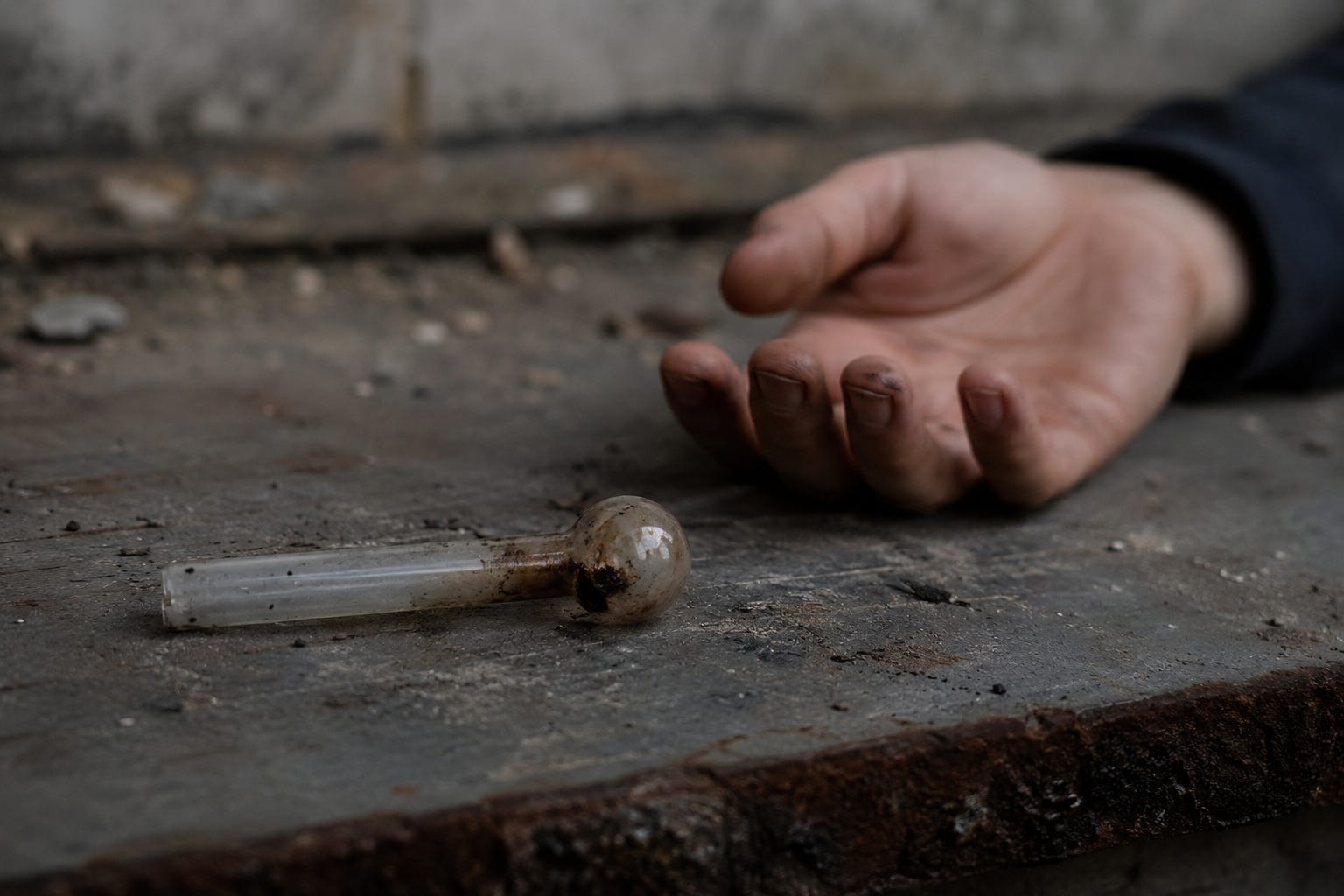
I see her moments before her death; she’s sitting contentedly in the nook of her building across the street. Her back against the wall, knees bent at 45-degree angles. Like so many around where I live and work, she clutches a small glass tube with both hands.
Her long, curly blond hair, fake breasts, and makeup contrast with her stubby beard and rugged, masculine physique. She glances up at me as I pass by.
Moments later, out my office window, I notice a flurry of activity. I see a body lying prone, face up, in the middle of the street
Someone yells,
“O.D!”
My reaction time is admittedly slow. I’m finishing up a phone call, and a tenant is asking me for something. Sadly, the commonality of unconscious bodies in the street has steadily chipped away at my sense of urgency. The sight is as common as flowers blooming in springtime.
Eventually, I grab my Naloxone and head for the exit.
Two staffers from next door and a couple of good Samaritans are already there
They hunch over the body.
One of them moves up and down in a rhythmic, pumping motion over the lifeless form. CPR is underway.
I learn the victim has already received two shots of Naloxone, but still has no pulse. They pound on her chest some more. A man with greater compassion than I presses his lips to hers and breathes air in. I see her chest rise—one human breathing for another. I worry about that.
Should he be putting his lips on hers? Will we be narking him next?
“His pulse has started up again!”
Yells one of the helpers
“Her pulse!” Corrects an indignant bystander.
The person could die today, but thanks to this devoted member of the pronoun police, we can take comfort in knowing that as she slipped from this world, her preferred gender was accurately identified.
A small crowd has gathered. One offers colour commentary.
“In goes the third shot, will she come around?”
It reminds me of a play-by-play announcer on Hockey Night in Canada.
Another man, visibly under the influence, offers an emotional, tear-filled, rambling tribute, describing the men saving this life as superheroes.
Most standing around, however, appear to care little whether she lives or dies. The atmosphere is eerily casual. What’s happening in front of me is so common that, for most in our neighbourhood, it’s barely noteworthy.
She coughs and sputters.
Then, like a WWF sportscaster losing his mind as Hulk Hogan rises from the mat for one of his iconic comebacks, a voice bellows from the crowd:
“Sheee’s coming baaack!”
“I’m going to hit her one more time,” says the staffer as he flicks the tip of the syringe to get the bubbles out.
Bang, into the shoulder, goes the fourth shot.
Her eyes pop open. She looks bewildered.
Two emergency personnel show up in a fire department vehicle. Soon she’s sitting up. Two more EMTs on bicycles pedal in, followed moments later by an ambulance.
The guys who saved her collect their spent Naloxone kits and head back to work, acting like nothing much happened.
Six medical professionals huddle around the victim. They try to check her vitals and help, but she isn’t interested in their assistance. She bums a cigarette off a bystander and pushes the EMTs aside; She’s out of here. The six stare at each other and shrug. One types a few notes into a laptop, another talks on the phone, then the call comes, and they scatter, responding to the next overdose victim.
I see her the next day. She’s wearing a green floral print dress with a brown top. Dark sunglasses cover her eyes. She sits at a picnic table a few meters away from where she died yesterday. A man in black sits across from her. The exchange is made. She has what she wants.
Will it kill her today like it did yesterday?
Oofda! This is a hard story.